What it’s based on
Our Sustainability Meter
Sustainable development and responsibility are extremely important to us, and we know they are equally important to our customers. We want to be open about the products we sell, transparent in our operations, anticipate future requirements, and commit to improving the state of our planet.
To help us meet the sustainability requirements of our discerning customers even better, we have developed Norex’s own “Sustainability Meter” to describe and highlight the level of sustainable development and responsible practices of our wine producers and manufacturers.
The meter makes it easier for our customers to obtain information about a producer’s sustainability and enables them to make purchasing decisions based on their own values. At the same time, by collecting and presenting sustainability information, we convey the importance of sustainability work to the actors in our supply chain and create positive pressure toward change and transparency.
We want to emphasize that this is not an official certification, standard, or sustainability label, but a simplified visualization of the results of Norex’s own sustainability assessment.
The Sustainability Meter is part of a sustainability assessment designed together with Norex’s sustainable development expert and sustainability working group. It examines sustainability from three different perspectives (environmental, social, and governance responsibility) based on Norex’s defined minimum sustainability requirements as well as a sustainability survey conducted with wine producers and its results.
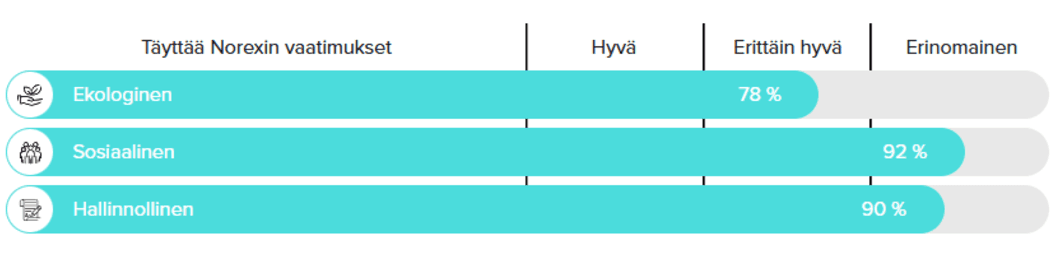
Each of the three areas is scored, and the meter bars indicate what percentage of each area’s maximum points the producer has achieved in our assessment. Below are examples of the visual appearance of the Sustainability Meter on our website.
Example meter for a producer who has participated in Norex’s sustainability assessment and responded to our sustainability survey:
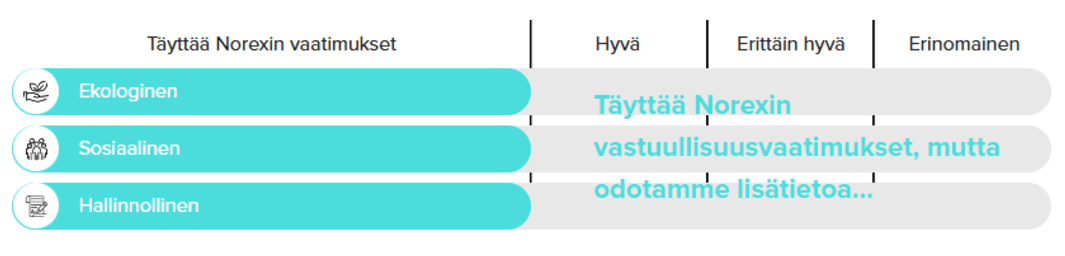
Example meter for a producer who has not yet participated in the sustainability assessment in its entirety, i.e., has not responded to our sustainability survey:

The sustainability assessment and the sustainability meter describing its results are indicative. Although the survey we used to gather additional information about producers’ sustainability is based on publicly researched information and strong expertise in the wine industry and related sustainable development issues, it is not perfect. At Norex, we have decided ourselves which questions to use and how they are formulated. Not all responses received from producers and their accuracy can be fully verified; instead, the responses are based on strong trust.
The scoring has been carried out by Norex itself and very straightforwardly. Positive responses from a sustainable development perspective earn points, while negative ones do not. The scoring will be explained in more detail later.
At this stage, only wine-producing and -supplying producers who have given their consent to the use of survey data are included, but the intention is to expand the meter over time to cover the producers and suppliers of all our products. Although the meter appears on product cards and descriptions, it describes the producer’s level of sustainability, not that of the specific product.
Stages of the sustainability assessment
We have defined in our procurement criteria Norex’s minimum sustainability requirements (7 ), which set the terms of cooperation from a sustainability perspective. When these terms are met, we can enter into a partnership agreement with the producer and add products to our sales range. These requirements include, among other things, commitment to the Amfori BSCI Code of Conduct as well as other Norex -defined terms related to e.g. compliance with laws and regulations, product safety and information, quality, financial responsibility, data protection and security , etc.
As part of the sustainability assessment, we conduct a sustainability survey, which provides us with more detailed information about the producer’s sustainability. The survey is conducted confidentially, and permission to use the data (consent) is requested from each producer separately.
This survey focuses on wine production and winemaking’s environmental and social aspects as well as the company’s governance and financial sustainability. The survey questions are based on publicly researched information and strong expertise in the industry.
The survey includes questions on topics such as the following:
- Environmental sustainability:
-
- Water use
-
- Soil management
-
- Pest control
-
- Biodiversity
-
- Circular economy
-
- Energy
Wine production consumes large amounts of water, , which has a significant environmental impact. . Water is used, among other things, for irrigating vines and in the wine production process, such as winemaking and cleaning wine cellars and other facilities . Water management in wine production is therefore a critical part of environmental sustainability. By optimizing water use, reducing consumption, and treating wastewater responsibly, the ecological footprint of wine can be significantly reduced.
Soil management affects the health of vines, wine quality, and environmental impacts. Environmentally sustainable soil management aims to protect and improve the natural balance of the soil, reduce erosion, and maintain soil vitality over the long term.
Environmentally sustainable pest control in wine production requires a balance in which the use of chemical pesticides is reduced and natural, biological, and cultural methods are favored. This not only improves the environmental sustainability of vineyards but also supports vine health and wine quality over the long term.
Biodiversity is an important part of environmentally sustainable wine production. It encompasses a wide range of animal and plant species, microorganisms, and their habitats in the vineyard environment. Promoting biodiversity in wine production improves ecosystem function, vine health, and reduces the environmental impact of production.
The circular economy aims for efficient use of resources and waste minimization. This means utilizing by-products such as grape skins and seeds, for example as compost or biofuel, recycling water for purposes such as irrigation, and producing energy from renewable sources. For packaging materials, recyclable and reusable solutions are favored, such as lighter glass bottles, tetra and bag-in-box packaging, or PET plastic bottles.
Wine production’s energy consumption must be reduced and renewable energy, such as solar and wind power, favored. Energy efficiency is improved, for example, by using modern equipment, temperature control, and optimized irrigation. From waste, such as grape skins, even biogas can be produced for energy. This reduces the carbon footprint and supports sustainable development.
- Social sustainability:
-
- Employee well-being
-
- Occupational health and safety
-
- Accessibility
-
- Sociocultural initiatives and actions.
Social sustainability in wine production means, among other things, fair working conditions, fair wages, and supporting employee well-being. It also includes community development, respect for local cultures, accessibility, and providing education.
The producer must take into account worker safety and minimize health risks, for example by providing safe working conditions. From an accessibility perspective, the aim is to make wine tourism and winery experiences barrier-free for everyone, including people with mobility limitations and other special groups.
Local sociocultural initiatives may include preserving traditional cultivation methods and local culture as well as collaboration with local communities. This supports regional identity, promotes cultural heritage, and leverages local expertise. The goal is for wine production to promote the well-being and cultural sustainability of both workers and surrounding communities over the long term.
- Governance and financial sustainability:
-
- Sustainable development management
-
- Sustainability strategy
-
- Commitments
-
- Ethical principles
Governance sustainability in wine production means responsible management, transparent operations, and regulatory compliance. It includes planning sustainable practices, obtaining certifications, and monitoring environmental impacts. Governance sustainability in wine production also emphasizes stakeholder engagement and integrating sustainable principles into the company’s strategy. This can mean making environmental and community decisions together with local residents, employees, and other stakeholders. Within the company, training and staff commitment to sustainability are key governance actions.
Financial sustainability ensures the company’s long-term profitability by optimizing resource use and reducing costs, for example through energy efficiency. The goal is to create a business model that supports sustainable development and provides financial security to local communities and workers. It also means risk management and adapting the business to market and climate changes. Wineries can benefit, for example, from sustainable development certifications and the added value they bring to their products, which can improve competitiveness. Supporting the local economy, such as procurement and investments from the local area, also strengthens financial sustainability and promotes socioeconomic development.
Survey responses are reviewed and evaluated by Norex’s sustainability working group, and we have a discussion with the producer if necessary to verify the information obtained through the survey. We give the producer the opportunity to supplement or clarify their responses if there is anything unclear or we need additional information.
Once the survey responses have been verified, , evaluated , and all information is compiled, we score the producer’s sustainability in three areas and compare the score to the maximum score for each area. . This produces the percentages that will appear in the Sustainability Meter. 50% of the points come from meeting our minimum sustainability requirements, and the other 50 % can be earned based on survey responses ..
Question scoring examples:
- Have you calculated your company’s carbon footprint in the last two years?
-
- Yes 2 points
-
- No 0 points
- What percentage of your energy comes from renewable energy sources?
-
- 100% 4 points
-
- 76-99% 3 points
-
- 51-75% 2 points
-
- 26-50% 1 point
-
- 0-25% 0 points
- What social responsibility actions have you taken in the last two years? (multiple choice)
-
- Donated money to charity 1 point
-
- Supported local employment 1 point
-
- Collaborated with local educational institutions 1 point
-
- Provided sustainability training for staff 1 point
In the future, we will supplement the data also using existing product information. This information includes, among other things, the proportion of more environmentally friendly packaging out of total packaging or the proportion of organically produced products out of total products, and the product’s carbon footprint, if available.
The producer’s sustainability assessment results will be displayed on all product descriptions and product cards for the producer’s products in the form of the Sustainability Meter.